
Everything below comes down to three things Hatch Duo holds to when designing a machine that has to operate around people.
Legibility before likeness. People do not need to recognize a machine as human. They need to know what it is about to do. Predictability of movement earns trust faster than any amount of added realism, and it earns it in minutes instead of months.
The form is a promise, so only make the ones the machine can keep. Every feature that implies a capability is a contract with the user. Eyes promise attention, a face promises understanding, an aggressive stance promises performance. Under-promise in the object and let the behavior over-deliver.
Familiarity is engineered, not borrowed. Warmth does not come from copying the human body. It comes from proportion, posture, deference, sound, and the way an object holds its place in a room. Any form factor can be made welcome by someone who knows which cues actually carry it.
Those three sound simple. Almost nobody in this category is doing them, and the reason that matters is commercial.
The industry is answering the wrong question
The humanoid robot conversation has been running on the wrong question for about a decade, and 2026 is the year that became obvious.
The question everyone has been asking is whether the machines can do the work. That one is now closed. Figure’s 02 platform spent eleven months on the line at BMW’s Spartanburg plant and contributed to more than thirty thousand X3 vehicles. Boston Dynamics committed its entire 2026 Atlas production allocation before the year began. Japan Airlines put humanoids into Haneda in May on a three-year trial, which is not a stunt when it comes from a legacy carrier in one of the most safety-conscious regulatory regimes on earth. And 1X started shipping NEO into private homes at twenty thousand dollars outright or four hundred and ninety-nine dollars a month. The capability curve is doing what capability curves do.
The question nobody has answered is whether people want these things anywhere near them. United Robotics surveyed eight thousand people across the US, Canada, France, Italy, and Germany, and sixty percent said they did not want robots to resemble people at all. Not arms, not legs, not heads, not faces.
A separate consumer study found sixty-five percent interested in owning a home robot alongside a dead-even split on whether they would be comfortable with a human-sized machine moving around the house, and when researchers pushed on the discomfort, the answers were not about robot uprisings. They were about physical danger and intimidation. People are worried about getting hurt and about being made to feel small in their own kitchen.
Put those two things side by side and you get the actual commercial problem of the next ten years. The machines are ready for the home. The home is not ready for the machines, and no amount of additional compute is going to fix that, because it is not an engineering problem. It is a design problem, and it is being handled badly by an industry that has spent a decade optimizing degrees of freedom and roughly ten minutes thinking about what it feels like to walk into your kitchen at two in the morning and find something standing there in the dark.
The reference model is wrong
Most humanoid programs are still working from an assumption they inherited from science fiction, which is that the goal is to approach a human being asymptotically and that acceptance arrives once the approximation gets close enough. Cross the uncanny valley, the thinking goes, and you come out the other side into affection.
The research is not kind to this. A representative study of just over two thousand households in Spain tested humanoid, semi-humanoid, and machine-like robots across caregiving scenarios, and the machine-like designs earned the highest trust of the three. Not the ones closest to human. The ones clearest about not being human. There is similar evidence out of industrial settings that anthropomorphic design not only failed to improve operator trust, it actively pulled attention away from the task, which in a safety-critical environment is a defect rather than a feature.
Hatch Duo would put it more plainly than the papers do. People are not waiting for a convincing person. They are waiting for a trustworthy thing, and those are different products with different design briefs.
What the dog already solved
The useful precedent is not in robotics literature. It is asleep at the foot of the bed.
A dog is a set of teeth and a predator’s nervous system sitting three feet from a sleeping child, and nobody in the house thinks about it. That is a genuinely remarkable outcome and it did not happen because dogs became more human. Fifteen thousand years of selection made them legible. A dog broadcasts its intent continuously and honestly through ears, tail, posture, gait, and the small pause before it commits to a movement. You always know what it is about to do.
It understands the geometry of a room and it yields inside that geometry. It has a bed, and the bed means something. It ages visibly alongside the family. It is bounded, readable, and affectionate inside a role that both parties clearly understand, and none of that required it to look like us. Arguably it worked because it did not.
That is the design brief for the machines coming into people’s homes. Not imitation, which is a race you lose by definition, since every increment of realism invites a comparison to an actual human being that the machine will fail. Domestication, which is a race you can win, because it is made of specific and buildable properties.
A robot is circuits and wiring and there is no percentage in pretending otherwise. But a Labrador is a domesticated wolf in any strict biological sense, and it still gets a name, a spot in the family photograph, and a level of trust no appliance has ever been granted. That trust was never built on resemblance. It was built on generations of behavioral legibility. We do not have generations. We have this product cycle, which means the legibility evolution produced by accident now has to be produced on purpose, in the industrial design and interaction layer, by people who know what they are doing. That is the work, and almost nobody is doing it well.
There is a time and a place for the humanoid form
Hatch Duo should be clear that it is not against the humanoid form. Hatch Duo is against using it as a default, which is what is happening, and which is the fastest available route to building something nobody wants.
The form earns its keep under one condition, and it is worth stating precisely: when you cannot change the environment and you cannot narrow the task. Homes, hospitals, retrofit factories, and hospitality floors are all built around a five-and-a-half-foot biped with two hands. Door handles, stair risers, counter heights, tool grips, and vehicle cabins constitute a legacy interface standard written in human proportion, and when you have no authority to rewrite that standard, building to it is rational. That is a real reason to build a humanoid. In Hatch Duo’s view it is close to the only one.
Everywhere else the form is a liability you are paying for twice. If the task is singular, the humanoid body is dead weight, added cost, and added failure modes for no functional return. If the environment is controlled, you are absorbing enormous mechanical complexity to solve something a fixed arm handled thirty years ago. And in clinical or caregiving contexts, the anthropomorphism can work directly against the outcome you are trying to produce.
Knowing when not to build the humanoid is the same discipline as knowing how to build one well, and Hatch Duo does build them when the condition is met. What rejecting the human form does not require, and this is where the argument usually goes wrong, is rejecting humanity in the object. Those are separable, and most of Hatch Duo’s work lives in the space between them. Four of Hatch Duo’s recent projects sit at four different points on that spectrum, and the spread between them is the actual argument.

What Hatch Duo designs for
The single highest-leverage variable in whether someone relaxes around a machine is not how it looks. It is whether they can predict what it is about to do. A robot that telegraphs its next action, decelerates before it turns, and orients its body before it moves an arm will earn trust faster than one that is twenty percent more human in appearance, and it will earn it in minutes rather than weeks. Intent has to be legible in the physical form itself, through a head or sensor mass that leads, a chassis with an unambiguous front, a posture that resolves cleanly at the end of a movement rather than drifting. Motion is the primary language these objects speak. Everything else is accent.
Then there is the state nobody designs, which is idle. A home robot spends the overwhelming majority of its operational life doing nothing at all, and that is what the user actually sees, a hundred times a day, out of the corner of their eye. Does it stand in the middle of the room the way a person waiting for instructions stands? Does it have a dock, a corner, a posture of rest that reads clearly as off duty rather than watching? The dog has a bed. That detail is not decorative. It is the specific mechanism by which a predator became a resident, and it is startling how few robotics programs have an idle state that was designed rather than defaulted to.
Compliance has to be visible before anyone will trust that it is real, which makes the surface itself the safety argument. 1X is instructive on this. A sixty-six pound machine wrapped in a soft lattice polymer and a machine-washable knit suit, driven by tendon actuators that yield on contact rather than pushing through resistance, communicates its safety case before anyone reads a spec sheet. Their design team, drawn out of Nike, Tesla, and Yeezy, framed the central question as whether the exterior reads as skin or as clothing. That is exactly the right question, and Hatch Duo thinks the answer is clothing every time. Clothing is honest. It says covered machine. Skin says imitation, and imitation invites the one comparison you cannot survive.
The same honesty principle governs faces. Every feature that implies a capability is a promise to the user. Eyes promise attention, a mouth promises conversation, expressive features promise emotional comprehension, and when the system cannot honor those promises the face stops being the thing that softened the machine and becomes the source of the disappointment. Under-promise in the form and let behavior over-deliver. Abstraction is not a compromise or a hedge, it is how you keep your word.
Sound is roughly half the experience and gets maybe five percent of the attention. Industrial humanoids run north of sixty decibels. NEO claims twenty-two. That gap is not a spec line, it is the difference between a resident and an intrusion, and it compounds every single day. The hum at rest, the pitch of an actuator under load, the sound of a foot landing on hardwood at eleven at night: these get designed deliberately or they get inflicted on somebody.
Deference should be built into the geometry rather than the software. Base curvature that naturally holds a person at a comfortable distance, height that sits below eye level when someone is seated, right of way surrendered by default in a hallway. A machine that yields is a machine that gets to stay in the house.
And all of it has to survive a decade, which almost nothing in this category is designed to do. Most robots are engineered to look correct in a launch video. A machine that lives with a family for ten years needs serviceable panels, replaceable wear surfaces, and materials that develop a patina instead of simply degrading. It also needs a physical vocabulary for privacy that a person can verify without having to trust a settings menu. A visible shutter. A hardware kill. A status light that is physically incapable of lying. When an object carries cameras, microphones, and a permanent connection through a private home, and when a meaningful share of its tasks are still being completed by a remote teleoperator, privacy stops being a policy question and becomes an industrial design requirement.
OOPLA, and building the humanoid on purpose
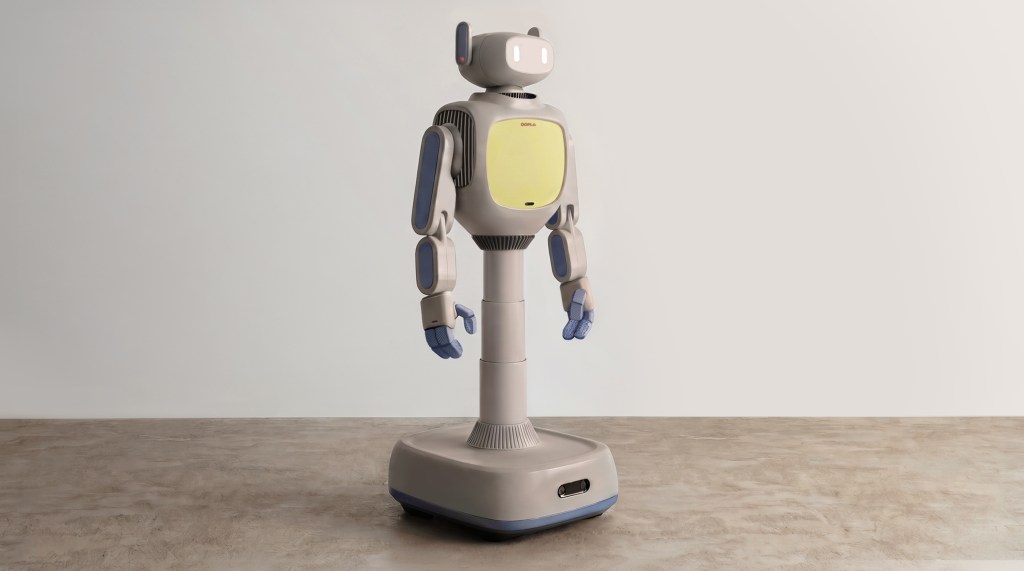
OOPLA is Hatch Duo’s own project, and it is the case where the humanoid form is the right answer.
It is a cleanup and assistive robot for preschools, daycares, and childcare environments, which is to say it deals with clutter and toys, which is to say it deals with the single most relentless and least discussed labor problem in early childhood education. Teachers in those rooms spend an enormous share of the day picking things up off the floor, and every minute of it comes out of the time they would otherwise spend with children. The environment cannot be redesigned around a machine, because it is already designed around three-year-olds. The task cannot be narrowed, because a toy is any shape, any weight, and anywhere. That combination is exactly the condition Hatch Duo described earlier, and it is why OOPLA has a torso and arms rather than being a vacuum with ambitions.
Architecturally it uses what the category is converging on, which is a wheeled base carrying a vertical pillar carrying a torso. That configuration is winning for good engineering reasons and Hatch Duo is not going to pretend otherwise. In a room full of small children it wins for an additional reason that has nothing to do with efficiency. A biped can fall. Near a toddler, a hundred-pound machine that can fall is not a risk profile anyone should be underwriting, and no amount of balance controller sophistication makes that conversation comfortable with a licensing board or a parent. Wheels are also quieter, cheaper, and better on battery, which means the money saved goes into the parts of the machine people actually touch.
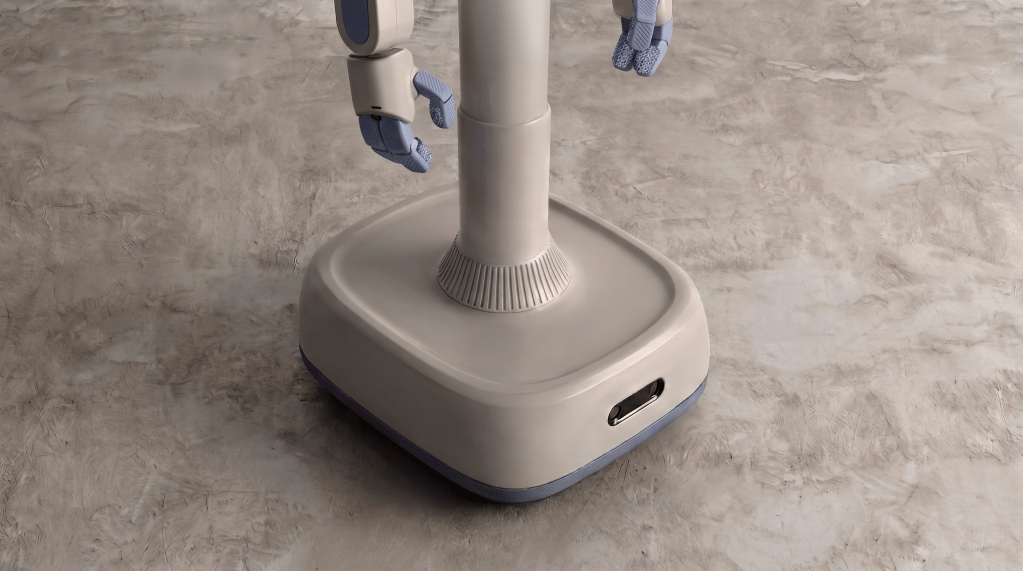
Where Hatch Duo diverged from the category is in how the thing is resolved. Most robots built on this architecture look like what they are, which is a set of brackets, actuators, and wire looms bolted onto a mast. That reads as skeletal, and skeletal reads as threatening, which is the entire aesthetic legacy of the Terminator sitting in the back of every adult’s head whether they acknowledge it or not. Hatch Duo treated every limb and every segment as a designed part instead of an exposed mechanism, with continuous surfaces, consistent radii, and seaming that runs across the whole object so it reads as one considered thing rather than an assembly that happened. That is not decoration. In a childcare center, a machine that looks assembled looks unfinished, and a machine that looks unfinished looks unsafe, and the director signing the purchase order is making that judgment in about two seconds.
The proportions are deliberately rounded and slightly juvenile, because children are the primary audience even though adults are the buyer. There is well-established work on this going back to Konrad Lorenz and the baby schema: rounded forms, a larger head relative to the body, softer transitions, and shorter proportional limbs are read by the human nervous system as young, safe, and needing care rather than posing a threat. Kids arrive at that read instantly. Adults arrive at it too, they just describe it as the robot seeming friendly. Hatch Duo tuned proportion, height, and mass distribution against that response rather than against a human reference figure, which is a completely different design target and produces a completely different object.
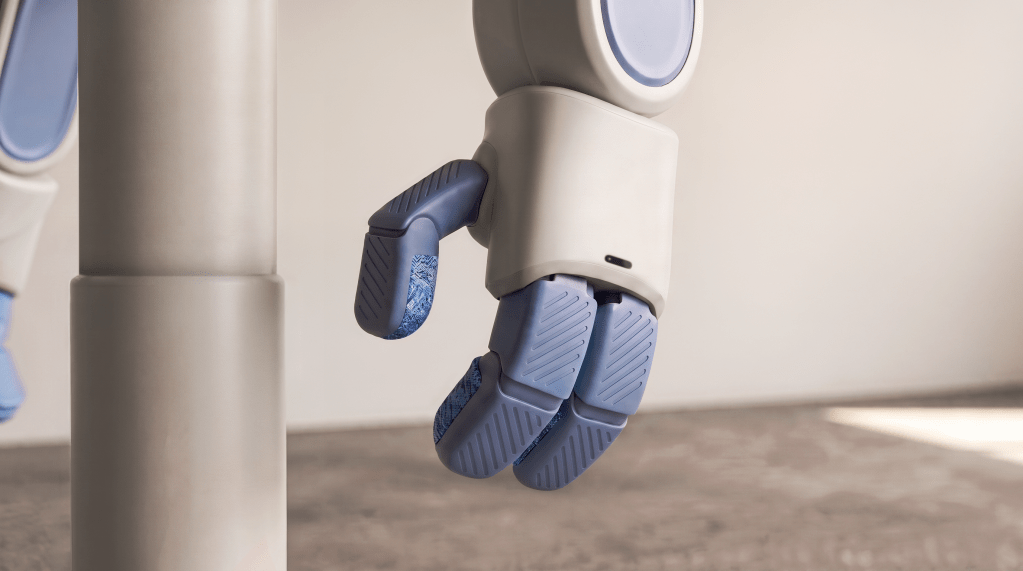
The hands are where most of the trust actually gets built. OOPLA has large, oversized digits, and there are three separate reasons for that. Big fingers telegraph intent, because a child can see the hand start to open well before it reaches the toy, and seeing it coming is the entire mechanism by which a machine stops being startling. Big fingers are also inherently safer, since scale removes the small gaps and pinch geometry that make small hands a hazard around small hands. And oversized digits are legible at a distance to a supervising adult across the room, who can tell at a glance whether the machine is holding something or reaching for something. Motion does the rest. Slow, deliberate, fully resolved gestures with a visible pause before commitment, which is the same legibility principle from the front of this piece, applied to the one part of the robot a four-year-old will absolutely try to grab.
There is a second-order effect Hatch Duo designed for on purpose. Children imitate what they see modeled in a room, and a machine that visibly participates in cleanup at the end of an activity is not just doing labor, it is reinforcing a routine the teachers are already trying to establish. That reframes the product from a device that takes work away from a classroom to a participant in how the classroom already runs, which is a materially easier sale and a materially better outcome.
Rovi, and the case for emotional ergonomics
Rovex Technologies brought Hatch Duo in to design Rovi, an autonomous supply rover for hospital environments. Vehicular, not bipedal, moving through corridors shared with staff, patients, and families.
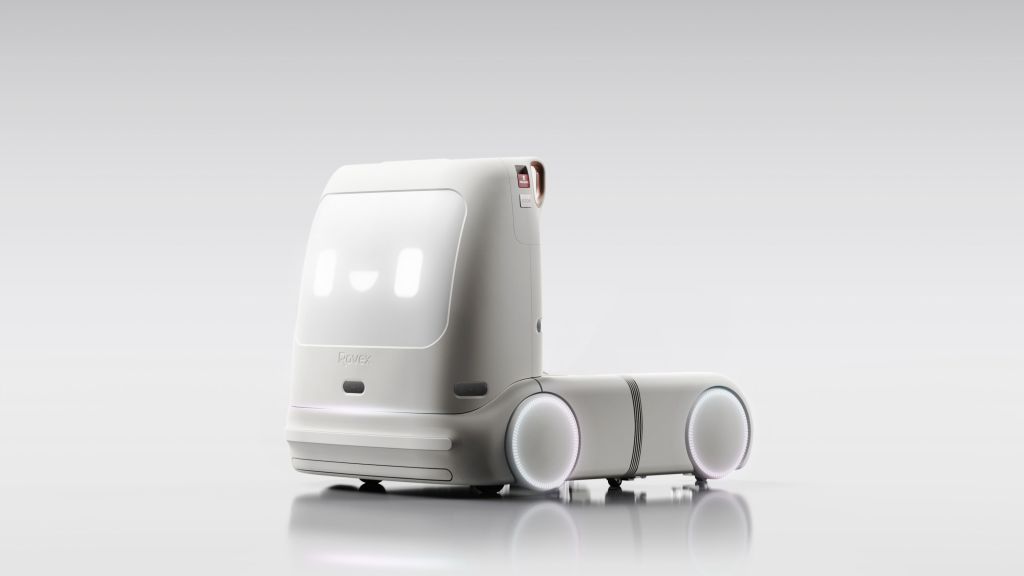
The path of least resistance on that brief is a rolling cabinet, and Hatch Duo argued against it for reasons that sit at the center of everything above. A hospital corridor is one of the most emotionally loaded spaces in the built world. The people in it are frightened, exhausted, or working hour twelve of a fourteen-hour shift. A machine moving through that space is never neutral. It is either a small additional stressor or a small point of relief, and there is no third outcome available.
Something that reads as pure equipment simply becomes one more piece of institutional hardware in an environment already drowning in institutional hardware. Something that reads as human-adjacent, without any pretense of being a person, gets a completely different reception. Staff begin to anticipate it. They give it room without resenting it for taking up room. Some of them name it, which is worth more than most of what appears on a features list.
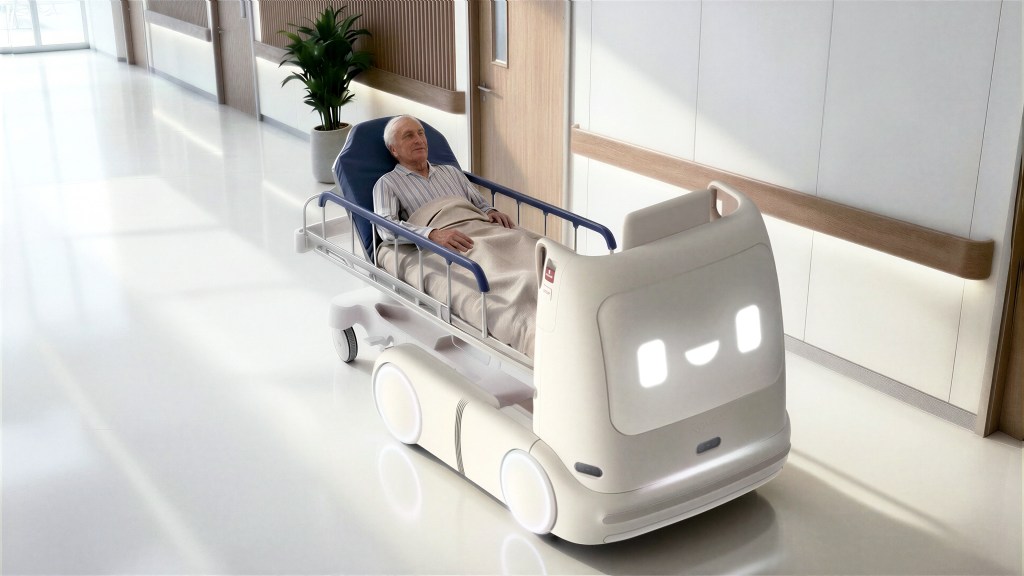
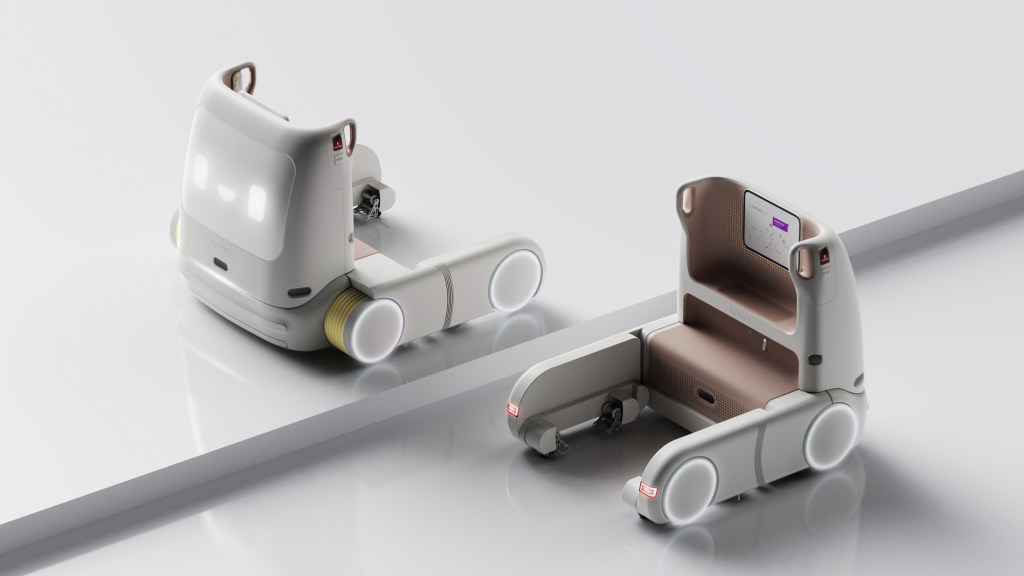
So Rovi has no face and no limbs and it is still an object with personality. The proportions read as approachable rather than industrial. There is a defined front that tells you where it intends to go before it goes there. Its height and stance were calibrated to sit below the eye line of a standing nurse, which is a deference decision rather than a packaging one. The surface language borrows from consumer electronics instead of medical carts, because the object needs to be welcome in a place where nothing else is.
Hatch Duo has started calling this emotional ergonomics. Physical ergonomics asks whether a body can use the object. Emotional ergonomics asks whether a nervous system can accept it. Both are measurable, both drive adoption, and only one of them reliably makes it onto a requirements document.
The generalizable lesson is that the humanoid form is only one delivery mechanism for familiarity, and it happens to be the most expensive and highest-risk one available. Familiarity itself can be engineered into nearly any form factor by someone who understands which cues actually carry it. Rovex went on to raise a four point one million dollar seed led by TenOneTen Ventures with participation from the Amazon Industrial Innovation Fund.
Shogun, and the problem of the crowded category
Kitchen robotics is the inverse problem, and in some ways the harder one.
Nobody is looking for a companion in a commercial kitchen. The brief is throughput, uptime, food safety, and labor economics, and the emotional register Hatch Duo spent the last two thousand words on barely applies. What applies instead is a category that has converged almost completely. Nearly every entrant is presenting some version of an articulated arm over a work surface, a meaningful share of them are sourcing actuators and gearboxes from the same small pool of suppliers, and the spec sheets have collapsed into each other to the point where a buyer walking a trade show floor cannot meaningfully distinguish between six booths. When the underlying hardware is common, the hardware is no longer the product. The object is.
That is the point where industrial design stops being finish work and becomes the commercial strategy, because perceived performance is a designed property whether or not anyone designed it. A buyer cannot evaluate cycle time on a showroom floor and an operator cannot audit repeatability by looking. They read quality off the object instead, and they do it in about three seconds. Stance and visual mass. Gap consistency. Whether the cable and pneumatic routing is disciplined or looks like a prototype somebody stopped working on. The acoustic signature under load. Whether the motion looks decisive or apologetic, because a machine that moves with conviction is assumed to be faster than one that hesitates, entirely independent of whether it is.

On Shogun the highest-value move was treating the enclosure as the product rather than as a cover. An exposed arm is a component someone bought. An arm resolved into a considered enclosure is a machine someone made, and that distinction is what converts a purchased subassembly into proprietary equipment in the mind of the buyer. It is also, not incidentally, the difference between being perceived as an integrator and being perceived as a manufacturer, which shows up directly in what you are able to charge.
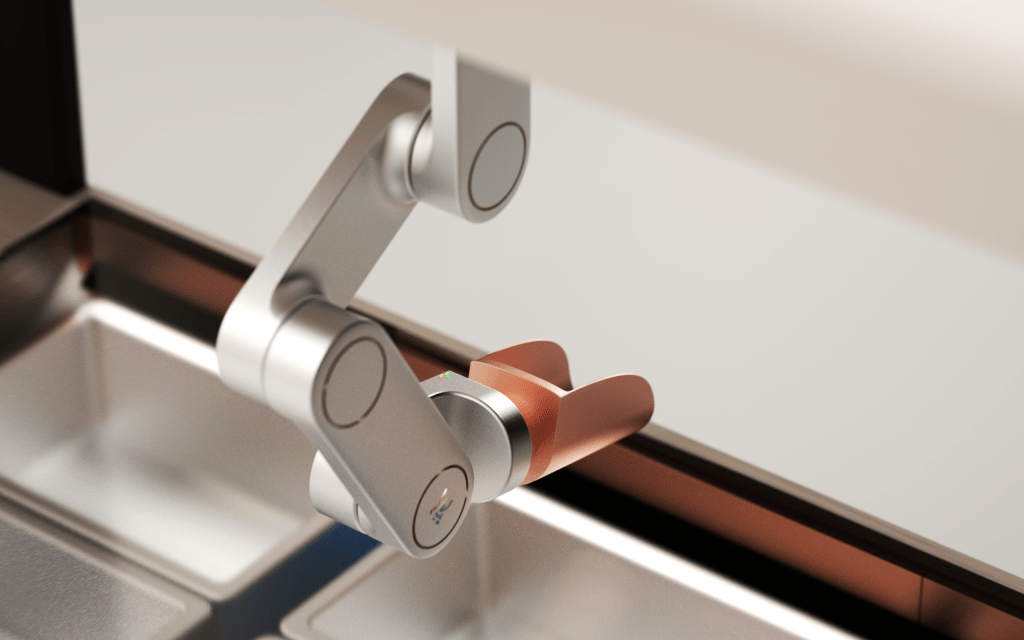
Cleanability does more work than people expect. In food service, clean reads as premium, full stop. Continuous surfaces, radiused corners, no crumb traps, no exposed fastener heads, sealed seams, and a wipe-down path an operator can complete in a single motion at the end of a shift. Most robotics companies treat this as a compliance checkbox to be satisfied. It is the most credible quality signal available in that environment and it should be driving the surfacing.
The last lever is restraint, which is counterintuitive in a category that defaults to aggressive industrial styling. Everyone is shouting. The differentiated position is calm. Equipment that is confident about its performance does not need to announce it in the sheet metal, and the same warm minimalism Hatch Duo brings to consumer work turns out to be unexpectedly powerful when it shows up somewhere nobody was looking for it.
UltraView, and the case for looking serious
Hatch Duo should be clear about something, because a reader who has made it this far could reasonably conclude that its answer to every robot is to make it friendlier. It is not. Friendliness is not the thesis. Appropriateness is, and sometimes the appropriate answer is a machine that looks like it means business.
UltraView is an autonomous aircraft inspection system Hatch Duo designed for hangar environments. Nobody in that building is a child, a patient, or a consumer. The people in the room are A&P mechanics, inspectors, and maintenance leadership, and above them sit airlines and regulators who will eventually ask whether the data this thing produces can be trusted enough to sign a release. In that context, trust is not comfort. Trust is confidence in the rigor of the instrument, and a soft, rounded, approachable object would actively erode it. A technician who has spent twenty years finding cracks in aluminum is not reassured by something that looks welcoming. He is reassured by something that looks like it was built to a tolerance.
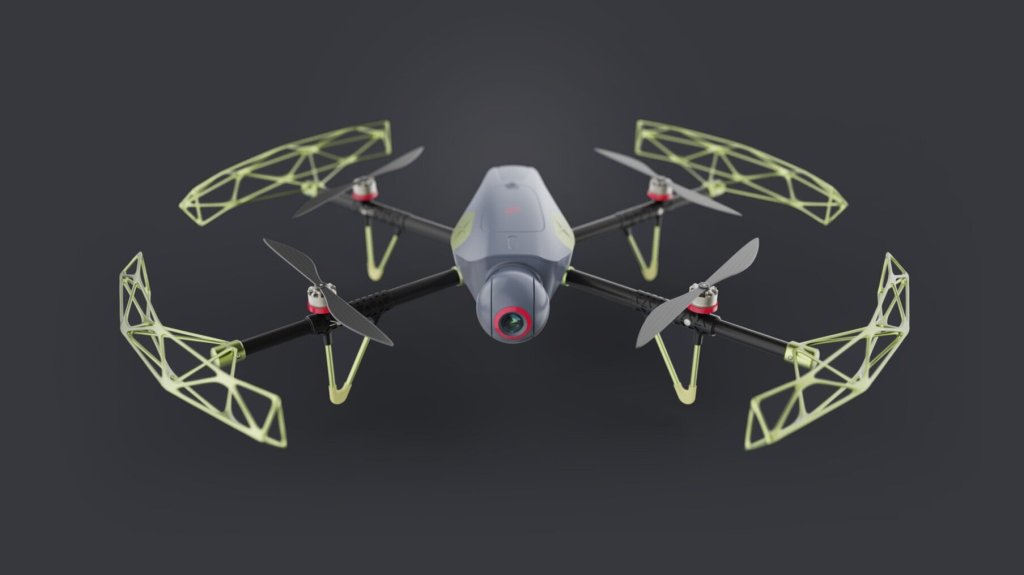
So UltraView reads as instrument-grade and slightly severe, and that is a deliberate outcome rather than an aesthetic accident. It carries the vocabulary of precision equipment: tight, resolved geometry, a purposeful stance, no consumer softness anywhere on it. It also mirrors the environment it works in. A hangar is vast, hard-surfaced, high-contrast, and completely dominated by the aircraft sitting in the middle of it. An object that ignores all of that reads as a toy on the floor of a serious building, and once a piece of equipment reads as a toy, no spec sheet will recover it. Matching the register of the room is a legitimacy move, and it is one of the cheapest ones available.
The formal reference is the dragonfly, and that choice does work beyond styling. Dragonflies are among the most effective aerial hunters on the planet, capable of hovering, darting, and holding position with a precision no other insect approaches, and they do it with compound eyes covering nearly the full sphere around them. Inspection is fundamentally a vision task performed while holding position near a surface. Borrowing that reference imports exactly the right associations, which are total visual coverage and absolute control of position, and it does so instantly, before anyone reads a word of collateral. Good biomimicry is not decoration. It is a shortcut into a set of meanings the viewer already holds, and the discipline is choosing a source whose meanings match what the machine actually does.
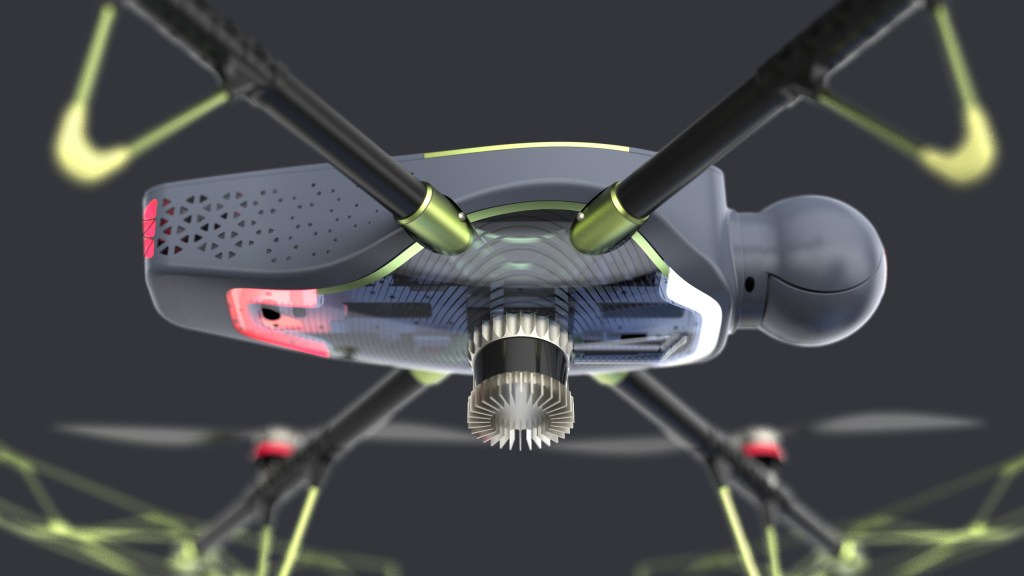
None of that suspends the rest of this argument. Intimidating is not the same as threatening, and the distinction lives in legibility. UltraView still has to telegraph its intent, because it operates in close proximity to technicians and closer proximity to an airframe worth more than the building, where an unannounced movement is a safety event and a contact incident is a very expensive afternoon. Its motion is deliberate and readable for exactly the reasons OOPLA’s hands open slowly. The principle did not change between a preschool and a hangar. Only the register did.
That is the point of putting these four projects next to each other. A childcare robot, a hospital rover, kitchen automation, and an aviation inspection platform have almost nothing in common at the level of form, and they were all designed from the same three commitments. The output looks completely different every time because the environment and the audience are different every time. The method underneath it does not move.
Where this leaves Hatch Duo
Come back to the three things we started with, because all four of those projects are the same argument wearing different clothes.
Legibility before likeness is why OOPLA’s hands open early and slowly enough that a four-year-old can see the grasp coming, why Rovi has a defined front and a stance calibrated below a standing nurse’s eye line despite having no face at all, and why UltraView telegraphs its movement even though nobody in a hangar needs comforting. It is also what a kitchen operator is reading when a machine moves through a task without hesitating.
The form is a promise is why Hatch Duo would rather abstract a face than build one the software cannot honor, why a juvenile proportion has to be backed by genuinely gentle behavior or it becomes a lie a child will catch first, why an enclosure has to be earned by what sits underneath it, and why an object that looks instrument-grade had better produce instrument-grade data.
And familiarity is engineered is the reason a limbless rover gets named by the night shift, the reason a wheeled pillar can be made to feel like a classmate rather than a machine, and the reason a dragonfly is the correct reference for an inspection platform while a friendly one would have been fatal to it.
Hatch Duo works across medtech, robotics, and consumer electronics, which is a strange combination on paper and exactly the right one for this moment. It means Hatch Duo designs objects that have to be clinically trustworthy, mechanically real, and emotionally desirable at the same time, and the robotics category needs all three simultaneously in a way that very few categories do.
Hatch Duo’s aesthetic position is warm minimalism, somewhere between Rams and Teenage Engineering, and in this context that is a strategic argument rather than a stylistic preference. The category currently oscillates between cold industrial menace on one end and unsettling imitation on the other. There is a great deal of open ground in the middle and it belongs to whoever arrives there with real craft.
The robots are coming into the house and onto the line. The engineering will get solved with Hatch Duo or without Hatch Duo. Whether people actually want them there is a design question, and it is the one Hatch Duo is built to answer.
Hatch Duo (www.hatchduo.com) is an industrial design and product engineering consultancy in San Jose, working with early-stage hardware companies across medtech, robotics, and consumer electronics. If you are building a machine that has to live alongside people, Hatch Duo should talk to you.
Sources
Figure — F.02 Contributed to the Production of 30,000 Cars at BMW: figure.ai/news/production-at-bmw
Forbes — Atlas Humanoid Robots Production ‘Fully Committed’ for 2026: forbes.com/sites/johnkoetsier/2026/01/06/atlas-humanoid-robots-production-fully-committed-for-2026-factory-will-build-30000-per-year
Japan Airlines — Japan’s First Demonstration Experiment for Utilizing Humanoid Robots at Airports Begins: press.jal.co.jp/en/release/202604/009502.html
1X Technologies — NEO announcement and specifications: 1x.tech
United Robotics Group consumer survey (8,000 respondents, five countries), reported in diginomica: diginomica.com/robot-futures-why-robophobia-bigger-problem-technologists-realise
Altman Solon — Humanoid Home Robotics Survey: altmansolon.com/thought-leadership/humanoid-home-robotics-survey-altman-solon
AI & Society (2026) — representative study of robot embodiment and trust in domestic care settings, N=2,010, Spain: link.springer.com/article/10.1007/s00146-025-02753-5
ACM Transactions on Human-Robot Interaction — Impact of Anthropomorphic Robot Design on Trust and Attention in Industrial Human-Robot Interaction: dl.acm.org/doi/10.1145/3472224
Dezeen — Inside the company building America’s first mail-order servant robot (1X design team profile): dezeen.com/2026/04/23/1x-neo-servant-robot-factory

